
The updated National Coverage Determination for transcatheter aortic valve replacement (TAVR) may change certain federal registry requirements.
As our partners in improving quality of care and outcomes for structural heart patients across Michigan, we hope you will agree that it does not diminish the value of participating in the Michigan Structural Heart Consortium (MISHC).
Continuing with MISHC offers a sustained focus on patient outcomes and meaningful return on investment by combining statewide collaboration, financial and operational support, and actionable data.
Why continued participation matters
1. Financial support remains in place
Blue Cross Blue Shield of Michigan (BCBSM) remains fully committed to MISHC, providing funding to support clinical data abstraction and reporting resources as well as provider value-based reimbursement (VBR) rewards, that remain in place – subject to applicable program requirements.
This support helps sites offset the resources needed for data abstraction, performance measurement, and quality improvement work.
2. Sites receive operational support – not just data
The MISHC Coordinating Center provides infrastructure and expertise that would be difficult and costly for individual programs to reproduce independently. Participating sites continue to receive support through:
- Performance and outcomes reports
- Data-quality review and audits
- Quality-improvement initiatives
- Statewide benchmarking and collaborative learning
- Identification and sharing of best practices
- Support for coordinators, clinical teams, and site leaders
- Guidance as federal requirements and evidence-development models evolve
This centralized infrastructure helps sites turn data into action.
3. MISHC helps demonstrate whether care is improving patients’ lives
Procedural success alone does not fully describe the value of structural heart care. Patient-reported outcome measures – particularly the Kansas City Cardiomyopathy Questionnaire (KCCQ) – help determine whether treatment improves symptoms, functional status, and quality of life.
Maintaining meaningful patient-centered measures allows sites to answer a fundamental question: Are our treatments helping patients feel and function better?
These data support patient-centered care, shared decision-making, quality improvement, and a fuller understanding of outcomes.
4. Registry participation supports benchmarking and improvement
The Transcatheter Valve Therapy (TVT) Registry and MISHC serve complementary purposes. The TVT Registry provides national benchmarking, while MISHC helps Michigan sites interpret results, identify local opportunities, learn from one another, and implement improvements.
Continued participation supports:
- Evidence-based, heart team collaborations across interventional cardiology, cardiac surgery, and quality leaders
- Invitations to MISHC meetings featuring national speakers and educational opportunities, including learning about cutting-edge procedure types and variables from national leaders
- Comparison with statewide and national performance
- Early identification of variation and emerging trends
- Tracking clinical and patient-reported outcomes
- Monitoring of operator procedural volumes
- Evaluation of improvement efforts
- Sharing effective practices among Michigan programs
Without a collaborative framework, a site may still collect data but have fewer resources for understanding what the data means and how to act on it.
5. MISHC supports compliance and readiness
Although CMS may no longer require a single national registry for every TAVR indication, sites continue to face important clinical, payer, and program requirements. These include:
- TVT Registry participation requirements for mitral transcatheter edge-to-edge repair
- Multidisciplinary Heart Team evaluation and documentation
- Operator volume tracking
- Quality-improvement requirements
- Coverage with Evidence Development studies for certain indications
- Public-reporting transparency considerations
- Value-based reimbursement requirements
MISHC helps sites maintain the data capabilities and workflows needed to respond to these requirements. Participation also positions sites to adapt more efficiently as CMS finalizes evidence-development and coverage expectations.
6. MISHC preserves the multidisciplinary Heart Team
MISHC strongly supports the Heart Team as a foundational component of every TAVR program. The collaboration reinforces comprehensive evaluation, appropriate treatment selection, shared decision-making, and consistent documentation.
This supports both regulatory readiness and clinical quality by helping to ensure that treatment decisions reflect each patient’s risks, goals, life expectancy, anatomy, and available surgical and transcatheter options.
7. Collaboration creates value that individual sites cannot achieve alone
Participation connects programs across Michigan so they can solve common problems collectively rather than independently. MISHC provides a trusted structure through which sites can:
- Learn from peers
- Compare approaches
- Develop shared standards
- Identify high-performing practices
- Address statewide opportunities
- Respond collectively to policy changes
- Shape the future of structural heart quality measurement
This results in a learning network that increases the value of each site’s data and experience.
8. MISHC is working to reduce participation burden
MISHC recognizes that data collection requires significant effort from coordinators, abstractors, clinicians, and program leaders. MISHC is working with senior leaders from the TVT Registry and BCBSM to explore sustainable models that:
- Preserve national and statewide benchmarking
- Maintain patient-centered outcomes
- Support participating coordinators and programs
- Capture the information needed to drive measurable improvement
Site representatives are encouraged to help shape this work so that the next phase of MISHC delivers high value while using staff time responsibly.
The return on investment
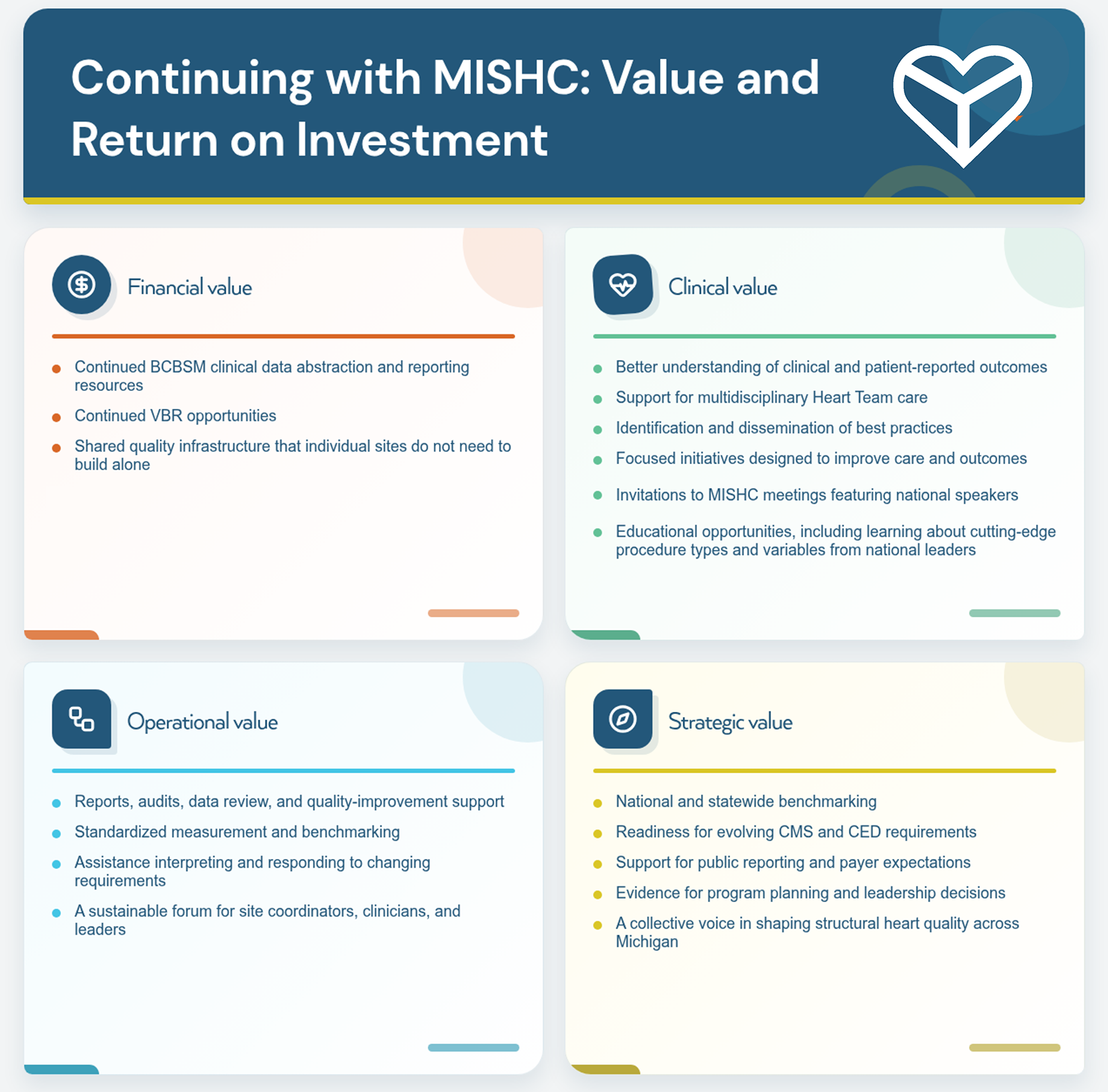
Download "Continuing with MISHC: Value and Return on Investment" for print.
Continued MISHC participation provides value across four areas:
Financial value
- BCBSM support for clinical data abstraction and reporting resources
- Continued VBR opportunities
- Shared quality infrastructure that individual sites do not need to build alone
- Centralized support that helps reduce duplicative local effort
Clinical value
- Better understanding of clinical and patient-reported outcomes
- Support for multidisciplinary Heart Team care
- Identification and dissemination of best practices
- Focused initiatives designed to improve care and outcomes
Operational value
- Reports, audits, data review, and quality-improvement support
- Standardized measurement and benchmarking
- Assistance interpreting and responding to changing requirements
- A sustainable forum for site coordinators, clinicians, and leaders
Strategic value
- National and statewide benchmarking
- Readiness for evolving CMS and CED requirements
- Support for public reporting and payer expectations
- Evidence for program planning and leadership decisions
- A collective voice in shaping structural heart quality across Michigan
Continuing with MISHC is an investment in quality, readiness, and patient outcomes. Blue Cross Blue Shield of Michigan (BCBSM) remains fully committed to MISHC, providing funding to support clinical data abstraction and reporting resources as well as provider value-based reimbursement (VBR) rewards, that remain in place – subject to applicable program requirements.
The MISHC Coordinating Center continues support through reporting, audits, quality-improvement support, and collaborative infrastructure.
Participation gives sites access to meaningful statewide and national benchmarking, patient-centered outcomes, shared best practices, and support for evolving regulatory and payer expectations.
The value of MISHC is not simply collecting data – it is turning reliable data into better decisions, more efficient improvement, and better outcomes for structural heart patients.